Infrastructure Week, Day 1: Bridges

How do we resolve a problem as widespread as nationally deficient bridge infrastructure?

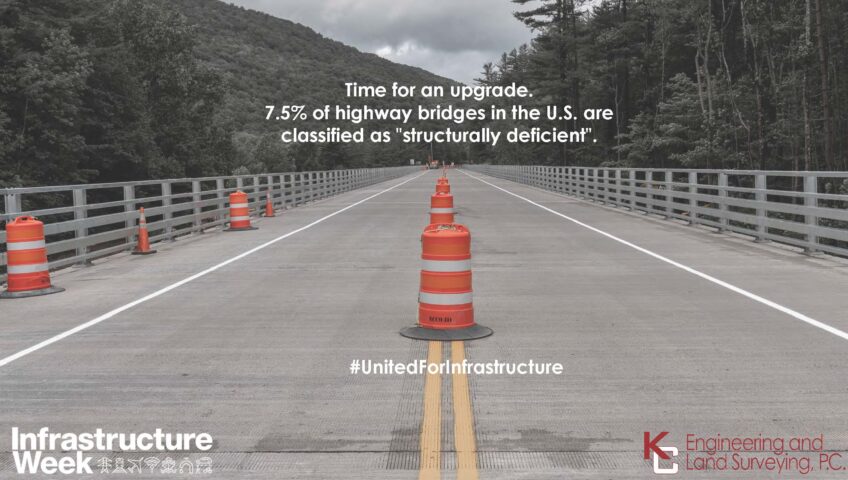
Year after year, America’s deteriorating infrastructure is so critically neglected that now, in 2022, we face a multi-billion-dollar backlog for the rehabilitation of bridges, a vital facet of the nation’s transportation infrastructure.

While the number of structurally deficient bridges in the United States is down significantly from years past, according to an Infrastructure Report Card provided by the American Society of Civil Engineers, around 188 million trips are taken every day across these deficient bridges. Rehabilitation needs for bridges are backlogged as much as $123 billion, an investment of over half of the funding already provided. These high repair and rehabilitation costs pose a nationwide challenge to state transportation agencies pursuing the construction of reliable infrastructure.

At KC Engineering and Land Surveying, P.C. (KC), structural engineering remains an integral part of our corporation’s contribution to providing safe, sufficient bridge infrastructure.

With projects like ‘Region 8 Ulster County Design-Build Bridge Replacements’, ‘Park Avenue Viaduct at 118th Street’, ‘Replacement of Route 59 Bridge over MNRR’, and ‘Greenkill Avenue Bridge Replacement’, KC is continuously able to provide survey services, design assessment, and structural analysis for the replacement and rehabilitation of damaged, deficient, and extremely vital bridge infrastructure in various counties of New York State.


 

Make Everyday Earth Day

Earth Day is an annual event held on April 22nd since 1970 to bring awareness and show support for environmental protection. But did you know that one of the inspirations for Earth Day were the 1960s anti-Vietnam War teach-in protests? This was an educational empowerment protest where the attendees were able to listen to lectures and hold free debates.

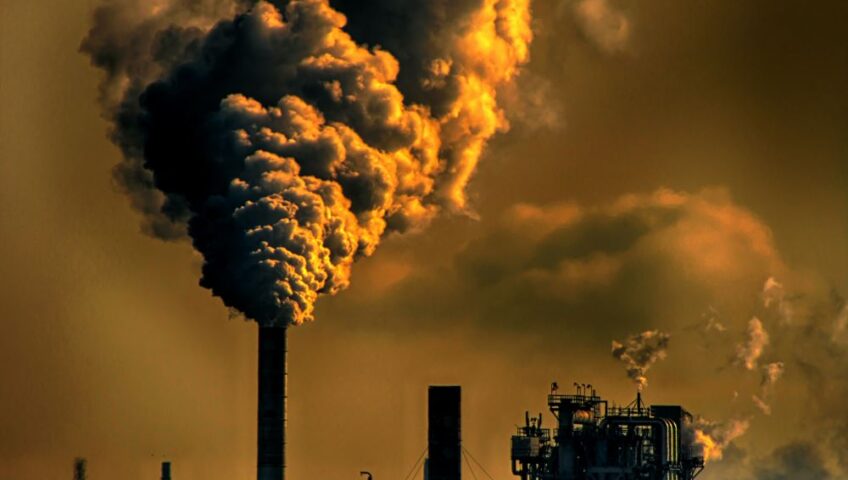
The terms “pollution” and “global warming” weren’t known or popular between the 1900s to the 1960s like they are in today’s society, which was due to the fact that even though the Industrial Revolution brought technological advances, industrial pollution was still minimal, and Americans didn’t know much or nothing at all about the topic. However, by the early 1960s, the rapid growth of factories resulted in constant smoke being released into the air. Americans started to become more aware of the effects of pollution on the environment. Americans started to notice how these factories dumped waste into the air and water sources, causing changes to the environment and leading to illness and death.

In the 1960s, Americans took over streets to protest about Counterculture and the Civil Rights Movement. This was a tumultuous and divisive decade, but it also became an inspirational decade to Senator Gaylord Nelson, who created the Earth Day movement to educate Americans about environmental issues. This non-profit organization focuses on climate crisis and what to do to protect our environment. Earth Day became a national spotlight, allowing more Americans to be aware of climate changes and what was causing them.

Now, Earth Day is a worldwide movement. Here are some ways you can make everyday Earth Day and protect the environment:
• Reduce, reuse, and recycle;
• Plant a tree;
• Buy non-toxic chemicals;
• Buy energy efficient light bulbs;
• Use less water; and
• Drive less.

To learn more about Earth Day, please visit https://www.history.com/topics/holidays/earth-day


It’s Our Anniversary!

This month we are celebrating the 39th anniversary of KC Engineering and Land Surveying, P.C. (KC). So, it’s a perfect occasion to look back and celebrate KC’s achievements over the years and thank everyone that contributed to them.

As we have always envisioned, KC rapidly continues to grow, taking on and successfully completing major projects throughout mid-Hudson Valley and New York metropolitan area. This success is thanks to our vision to always provide the best results to our clients. We are able to provide the best results on each project we take by staying up-to-date with the latest technology and continuously training our personnel with the latest procedures. Our personnel are always learning on and off the field and their dedication to grow is evidenced with each project and the results we achieve. We have successfully completed multiple multi-billion-dollar projects on time and within budget, and we are looking forward to continuing delivering successful projects. We believe there is always room to learn and to never stop improving, which is why our employees also continue to grow professionally and personally. As a token of appreciation, every year we announce on our newsletter each personnel that we promote, any licenses they have obtained, and/or any personal achievements they want to share with KC. We are grateful to have such talented, dedicated, and passionate employees who value KC and what we stand for. We also recognize the importance of our clients and colleagues who have trusted us for many years and contributed to our success. We are honored, thankful, and value all KC employees, clients, and colleagues for being part of our success over the years.

To stay up-to-date on all of KC’s achievements and news, please visit kcepc.com.

Happy anniversary KC!


World Water Day

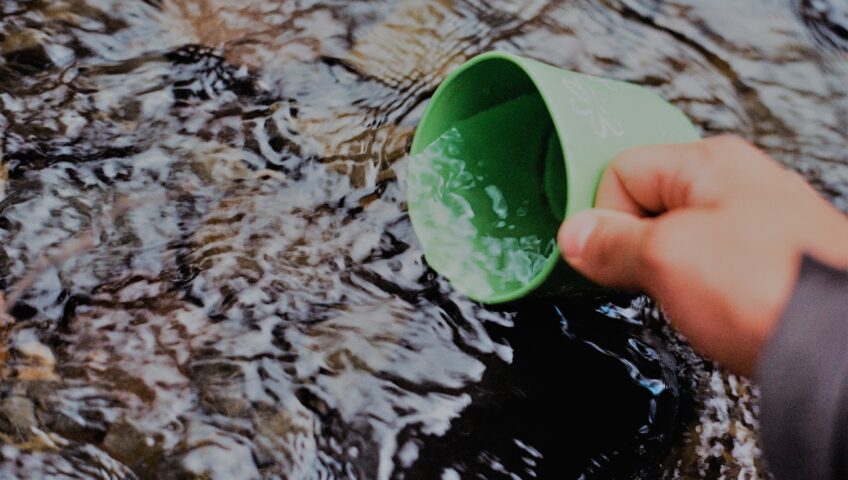
World Water Day is an annual observance held on March 22nd since 1993 to bring awareness of the importance of worldwide freshwater. In honor of this day, it’s important to bring awareness on how important freshwater is, the main concerns on how freshwater is suffering in today’s society, and how we can address these freshwater issues we are facing.

We all know that freshwater is a vital resource for life due to being an important aspect of supporting human civilization and our ecosystems. But did you know that less than 3% of the world’s surface is freshwater? Therefore, is important to come up with solutions and work together to preserve freshwater worldwide. We might not see freshwater as a luxury since we can easily obtain it, but in other parts of the world, it is hard to obtain clean water. Freshwater is important to our food production because, without freshwater, it would be impossible to harvest sustainable crops and food. Having access to clean water is indispensable for agricultural production. In addition, freshwater is one of the main sources to feed the farmers’ animals.

One of the concerns of freshwater is pollution, and it is the main reason why our freshwater is suffering today. Pollution has been taking over our freshwater resources such as rivers and lakes, which is making our water undrinkable, and it is also causing harm to our wildlife. Therefore, so many species of our wildlife are in danger of extinction. One of the reasons why we cannot maintain proper sanitation to our rivers and lakes is due to overuse. The overuse of these freshwater resources can be trigged by many factors, such as population growth. Population growth causes our rives and lakes to dries up, which leads to freshwater shortages.

We need to act now and address these freshwater concerns because this will be a big and dangerous issue that our future generations will have to face. In order to fight the freshwater crisis, we need to come up with strategies and approaches worldwide. Some important areas that we can approach are getting educated on these issues and coming up with ways to change our lifestyles, coming up with new technologies to recycle wastewater, and improving our infrastructure.

We need to unite globally and individually to do our parts in maintaining our freshwater resources no matter what side of the world we are in.


International Women’s Day

Today, March 8th is International Women’s Day, a global holiday that uplift the voices of women worldwide and celebrates the impacts they have made throughout history. Whether the impacts were made culturally or historically, today is a beautiful day to highlight some engineering heroes’ achievements who paved the way for the female engineers of today.

Even with gender and/or racial inequality, the following women made history in National Aeronautics and Space Administration (NASA):

  • Mary Jackson was born in 1921 in Hampton, Virginia. She was an African-American NASA engineer who made it possible for America’s first men to travel to space. She was known as a human computer who, behind the scenes, calculated the orbital trajectories. Aside from engineering, she was passionate about advocating for women and minorities in the engineering field, so after working 30 years with NASA, she retired in 1985 and shifted careers to focus on becoming an equal opportunity specialist to help women and minorities.
  • Dorothy Vaughan was born in 1910 in Kansas City, Missouri. She was the first African-American supervisor for the National Advisory Committee for Aeronautics (NACA). She advocated for her employees by making sure they received promotions and pay raises. After segregation ended in 1985, that is when NACA became NASA and Vaughan became a programmer for a new division that was created, named Analysis and Computation. While working in this division, her group worked behind the scenes and played a major part in the success of a satellite-launching rocket called Scout. Vaughan retired in 1971.
  • Katherine Johnson was born in 1918 in White Sulphur Springs, West Virginia. She was a pioneer in mathematics that landed her a job at NASA as a Trajectory Analysis for Alan Shepard’s mission in 1961, and then for John Glenn's orbital mission in 1962. While working for NASA, she was the behind-the-scenes math genius that made many missions like space shuttle, Earth Resources Satellite, and Apollo’s Lunar Lander successful. Thanks to her achievements, she received the highest civilian honor in the United States: the Presidential Medal of Freedom in 2015. Johnson retired in 1987.
  • Kalpana Chawla was born March 17, 1962, in Karnal, India. She received a Bachelor of Science degree in aeronautical engineering in India, and later on moved to the United States to continue her education and received a master’s degree in aerospace engineering. After being naturalized in the United States, she became an astronaut, engineer, and the first woman of Indian descent to go to space. Chawla lost her life during a mission, but her legacy continues to live through her work. Her research helped other astronauts understand health and safety during spaceflight. She continues to be an inspiration for many immigrants who are chasing the American dream.

For more information about women who made history in NASA, please visit: https://www.nasa.gov/