


Seasonal Tricks for Environmental Treats

The autumnal equinox is in full swing and it’s almost Earth Day’s half birthday, so what better way to celebrate than with a few tips for seasonal cleaning and conservation?

Double, Double, Soil and Trouble

It’s easy to resent those beautiful maple trees in your front yard when you remember that they’re deciduous, but before you start stretching to prepare your body for hours of raking, consider mowing the lawn. Not only is it faster to deal with leaves using your mower, but these leaf pieces can be used to enrich the soil beneath your grass.

To mulch your leaves and feed your lawn, Scotts Miracle-Gro recommends taking off the grass catcher and mowing your leaves into dime-sized pieces. According to Scotts, “you’ll know you’re done when about half an inch of grass can be seen through the mulched leaf layer.” Other lawncare services say that it’s sufficiently mulched when you can see 50% of the grass through the leaf pieces, so either unit of measurement works. The more the leaves are mulched, the faster they will decompose.

Once the leaves are cut into small pieces, microbes and worms in the soil will start decomposing it for you, and your lawn will be happier as a result – as will your back, which avoided raking!

Waste Not, Haunt Not

The only thing more terrifying than Halloween is improvidence – luckily, it’s easy to get festive while staying eco-conscious. Blogger Beth Bucynski wrote an article for Care2 Causes sharing some of her favorite tips for recycled Halloween decorating, with everything from thrift-store scarecrows to cheesecloth ghosts. Here are a few of her suggestions:

Next time you finish the rest of the eggs in your fridge, hold onto the egg carton. With some careful cutting, some non-toxic paint, a few strands of ribbon, and a few googly eyes, you can make an upcycled bat with ease.

The same can be done with several empty plastic milk jugs and ribbon to make an upcycled skeleton!

If you saved some of the leaves before making mulch, throw them into a few biodegradable garbage bags, apply some felt eyes and teeth, and show off your very own trash tarantula.

Night of the Composting Garden Bed

With Halloween right around the corner, there’s a good chance you’ve got a pumpkin or two floating about somewhere – but what’s your plan for November? Rather than hiding it in your trashcan or letting it rot on your porch through January, compost it. Pumpkins are great composting material, so long as you take a few careful steps in preparation.

Make sure your jack-o’-lantern’s candles are removed, as well as any candle wax inside. If your pumpkin is decorated with ribbons or stickers, take these off too. According to Earth 911, pumpkins that have been painted or coated with a preserving sealant or glitter should not be composted, but if only a portion of the pumpkin is coated, it’s okay to cut off that portion and compost the rest. Finally, remove any pumpkin seeds to prevent germination in the compost pile.

Just like with the leaves, the more cut up/divided the pumpkin is, the faster the rate of decomposing – a good excuse for smashing pumpkins.

According to Earth 911, if you don’t have a compost bin, you can dig a hole in a garden bed or your yard and add the pumpkin. Next, replace the soil over the hole, and it will compost naturally through the winter. In the meantime, you can rest assured knowing your lawn is taken care of, your egg cartons didn’t go to waste, and your pumpkin will nourish your flowers in the spring.

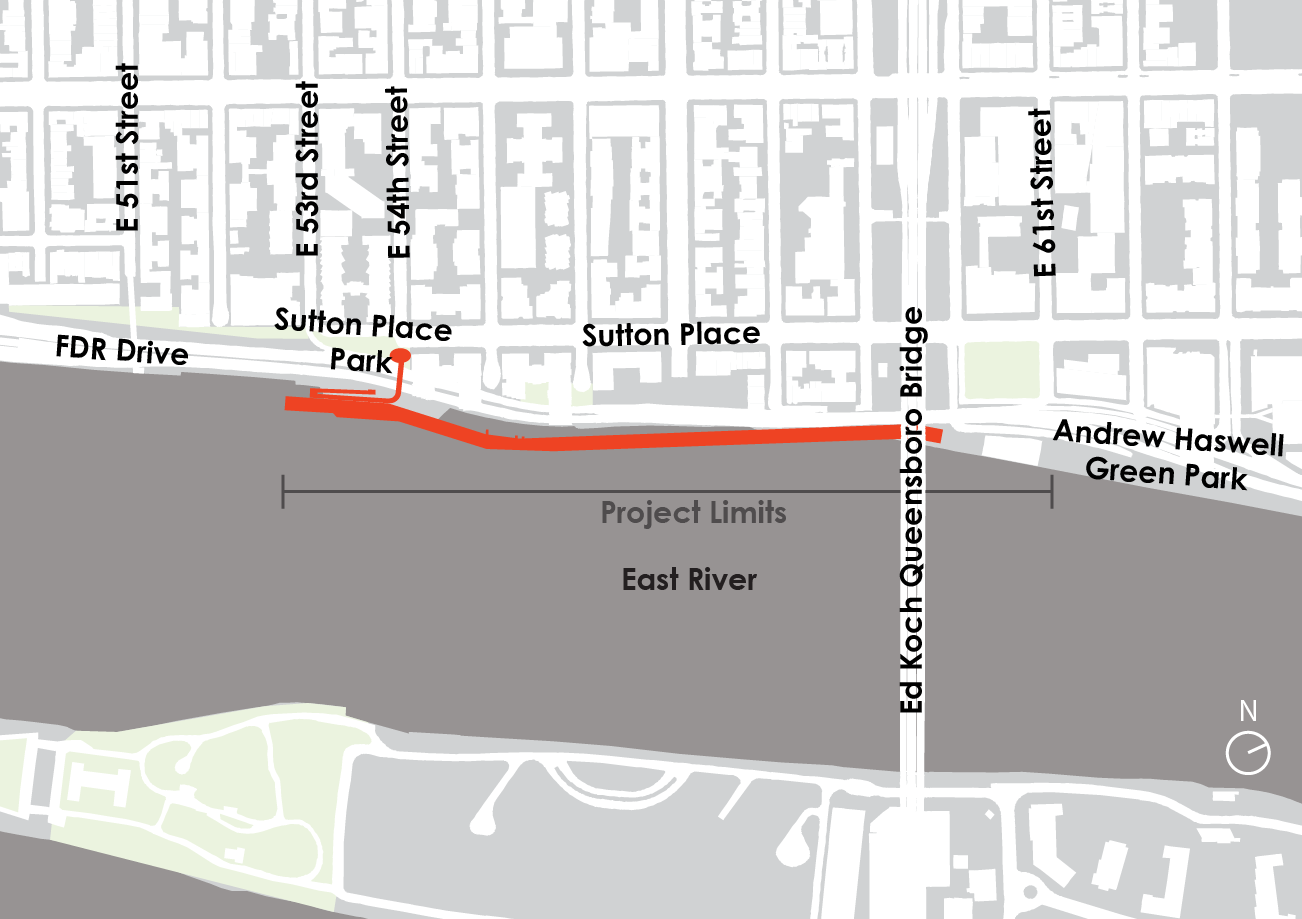
NYCEDC East Midtown Greenway Survey Project

The East Midtown Greenway (EMG) is the second phase of a three-phase development known as the East Midtown Waterfront Project (EMWP). The intent of the EMWP is to construct a continuous public waterfront esplanade over the East River in Manhattan. The EMG’s southern and northern termini are East 53rd Street and East 61st Street. The project also includes a new pedestrian bridge, which will provide access the esplanade at 54th Street and Sutton Place South.

KC performed the topographic survey, utility survey, and easement survey for the project. Work associated with the production of these deliverables included a comprehensive investigation of all available record utility and government agency maps. KC also researched available design drawings, as-built drawings, and aerial maps spanning approximately 80 years to understand site conditions, both above- and below-ground. KC's survey crew also coordinated with an arborist to accurately measure, classify, and record all trees within the project limits.

KC assisted in providing an existing conditions report. Provided narratives entailed a detailed description of the project land use, ownership, and zoning. This report also included a written description of onsite utilities and important features, including an existing 11-foot gravity retaining wall and a comprehensive engineering investigation of an existing bridge located adjacent to the project area.

In addition, KC, the Engineer of Record for the new 54th Street pedestrian bridge, is actively coordinating with the New York City Economic Development Corporation and a bridge architectural firm to provide a bridge design that will be visually appealing, will meet the high expectations of the community, and will adhere to the design standards set forth by both the New York City Department of Transportation and the New York City Department of Parks and Rrecreation.


How AI is Changing the Construction Industry

With routine development of advanced technology, the construction industry remains well-poised to reap the benefits from the likes of artificial intelligence (AI) and robotics.

Compared to other markets, AI remains a marginally small factor in the under-digitized construction industry. However, the presence of fast-growing technology sets AI on track to have a much greater impact in the future.

According to a 2017 McKinsey report, AI has a place in nearly every construction phase, from design through post-construction and every minuscule task in between.

AI is suited to overtake four major components of construction: planning or design via simulation of maps, construction plans, and blueprints; administration, where AI is adept to manage and control tasks in a streamlined fashion; construction methodology, done by providing a basis and guide for construction; and post-construction, where AI can be implemented into completed structures.

However, the primary concern for AI is industry takeover, a theory that construction workers will be replaced by computers created to perform the same tasks with arguably more accuracy and less human error.

While there’s no denying the benefits of AI and robotics in construction, there are certainly a number of associated risks.

Other industries, such as fast-food, finance, and grocery stores have already seen a reduction in workforce numbers because of advances in computer technology. What’s more, talk of AI taking on industries such as health care and transportation have become less-farfetched as these ideas inch ever-closer to becoming reality.

And, while the thought of perfecting processes and systems sounds appealing, the idea of the world we live in being inundated by AI that is unable to deliver the human touch or incapable of accommodating anomalous circumstances, due to a lack of breadth in data, is not.

By defaulting all responsibilities to an artificial system, we ultimately run the risk of putting complete—and excessive—trust into a system only as good as the inputted data, losing human compassion and judgment, and displacing workers.

No matter the consensus on AI in construction, there’s no doubt that it’s here to stay.


Modern Marvel: Morpheus Hotel

The Morpheus Hotel in Macau, China. Photo courtesy of Ivan Dupont.
Zaha Hadid's Morpheus Hotel. Photos courtesy of Virgile Simon Bertrand.
The interior of the Morpheus Hotel. Photos courtesy of Virgile Simon Bertrand

Featuring the self-proclaimed “world’s first free-form high-rise exoskeleton,” Melco Resorts and Entertainment’s Morpheus Hotel in Macau, China officially opened for business as of June 15, 2018.

The hotel was designed by Zaha Hadid Architects, spearheaded by the late Dame Zaha Hadid who passed away in 2016. According to South China Morning Post, Hadid’s partner Patrik Schumacher is the new principal of the practice and led the effort to finish the Morpheus Hotel.

With 147,860 square miles of space across all 42 stories of the building, the Morpheus Hotel has over 770 guest rooms, suites, and sky villas, but what really stands out as an engineering marvel is its exoskeleton. Supported by two central towers that connect at the ground and roof, the exoskeleton acts as a strengthened mesh around the building. Additionally, the center of the building has a portion of negative space, where a series of bridges connect each tower (for extra support as well as to provide a unique space for restaurants, bars, and guest lounges).

Moving inside, the internal layout of the building is deeply affected by the external design. With the ability to take on gravitational and lateral loads, the exoskeleton eliminates any need for internal structural support, allowing for open, uninterrupted space – maximizing the building’s interior. The central atrium extends upward the entire height of the building, allowing guests to see exposed space without their view obstructed by support beams.

In addition to high-performance glazing that helps minimize solar gain, the ridging of the exoskeleton also provides shading, allowing the hotel to localize air conditioning only to zones used by staff and guests rather than cooling the whole atrium.[6]

According to Viviana Muscettola, ZHA’s project director, “The expertise of all members of the Morpheus team has created new possibilities for architecture. The comprehensive parametric model combined all of the hotel’s aesthetic, structural, and fabrication requirements and will radically change how our built environment is planned and constructed.”


Orange County Veterans Memorial Cemetery Project

KC, in conjunction with Behan Planning and Design, developed a master plan for the Orange County Veterans Memorial Cemetery as well as provided architectural design and engineering for pavilions, lighting, landscaping, and a plot locator.

The KC team analyzed the layout of the site and developed a master plan that included site topography, roadway configuration, access and internal circulation, signage for both vehicles and pedestrians, landscaping and lighting, water, sewer, irrigation, drainage facilities, and an evaluation of the existing structures and facilities.

Several draft plan approaches were presented to the Veterans Affairs Board for discussion. A single plan, including elements from multiple plans, was fully developed into the master plan document for the facility.

The remaining term of the agreement will be used to help the County design and implement additional facilities within the cemetery. Some potential new facilities include a second dedication area, a directory kiosk, and a new columbarium. KC will prepare full design and bid/specification packages for these projects.