What is a Cofferdam?

Have you ever crossed a bridge with its support rooted underwater and wondered how engineers managed to construct it or how they maintain it? You certainly would not be the only one.

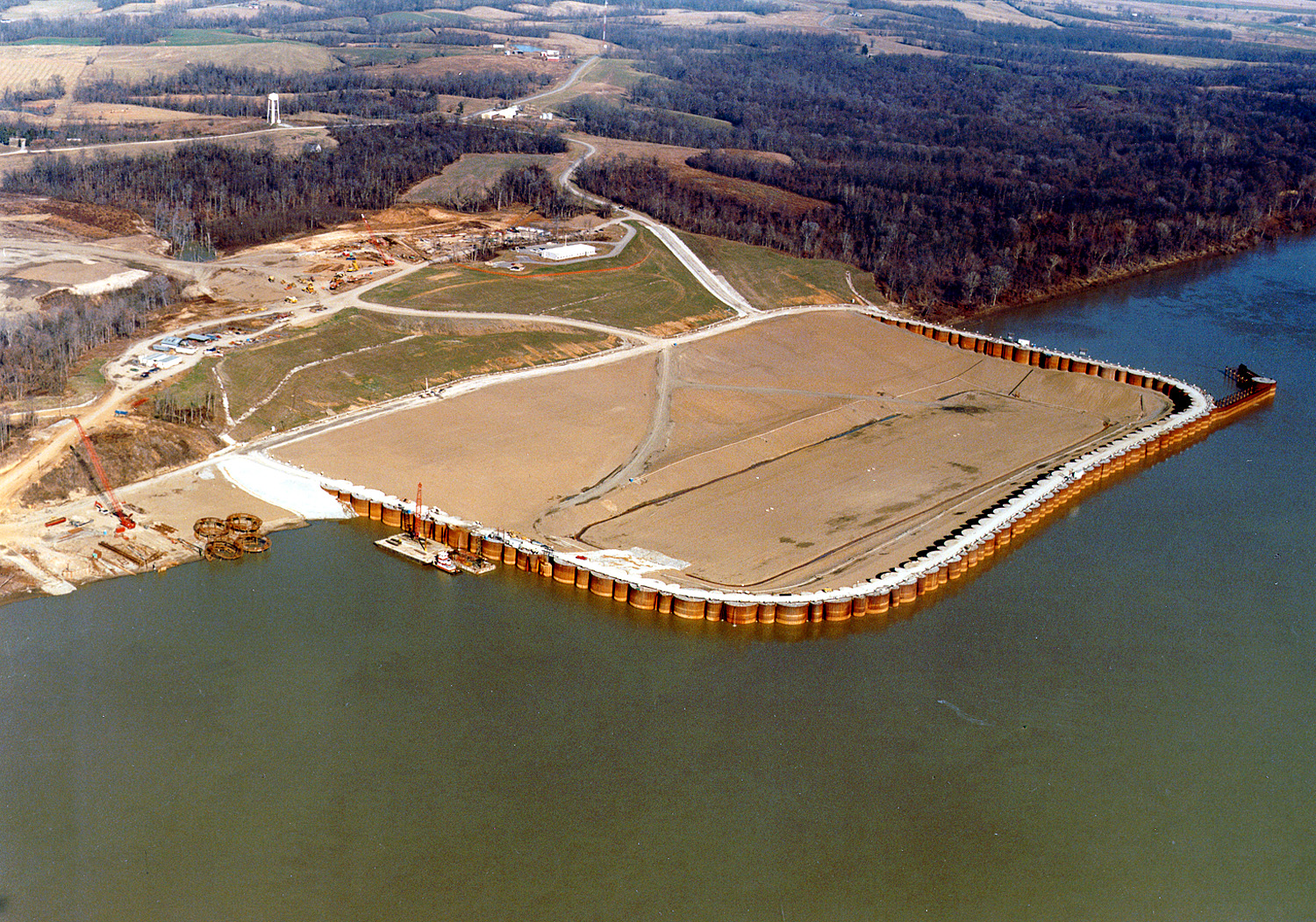
Underwater bridge supports are typically accomplished through the building of cofferdams, which are temporary barriers – essentially 3- or 4-sided boxes – that are built within bodies of water and allow for water to be pumped out, making a previously flooded area accessible for construction purposes. Engineers tend to avoid designs featuring underwater construction because it can be expensive, but when necessary, cofferdams prove to be much safer and more efficient than other methods, and they are a more reliable solution in the event of a long-term project.

Cofferdams date back at least to the time of Ancient Rome. Their engineers utilized them in the creation of piers for their bridges and aqueducts. According to legend, King Cyrus of Persia used earthen cofferdams to redirect water from the Euphrates river, aiding him in his capture of Babylon and thereby facilitating the birth of the Medo-Persian empire.

Nowadays, cofferdams are created by using pieces of corrugated steel called sheet piles, which are strong enough to hold back water. These piles are driven into the soil underwater, interlocking to create a cantilevering wall around the chosen area.

Some primary types of cofferdams used by engineers include the following:

  • Earthfill: The simplest of all cofferdams, these are earthen embankments that are built around a space that needs to be enclosed. Made from a mixture of clay, sand, and gravel, they are built wherever the water depth is no more than 1.8 meters. The height of the dam is kept 1 meter more than the max water level.
  • Rockfill: If the water depth to be retained is more than 1.8 meters, engineers use stone or rubble in place of an earthen mixture – but only if the stone is available to be pulled in copious amounts from areas near the project site.
  • Braced: Likely the most common type of cofferdam because of its low cost, this dam consists of vertical or horizontal sheeting with internal struts and is utilized when excluding shallow water, earth, or both, since it is difficult to drive piles inside an underwater bed in those conditions. They are frequently used in the construction of bridge piers and abutments.
  • Cellular: These dams derive their name from the way the sheet piles are constructed in special shapes to form a series of cells that are interconnected and filled with soils, providing stability against lateral forces. They are used when a single-walled braced cofferdam is impractical, commonly in the construction of dams, locks, or weirs.
  • Single-walled: This type is preferred when the area to be enclosed is particularly small and the water depth is roughly 4-6 meters, such as in bridge construction. These cofferdams are built with wood sheets along the perimeter and supported by steel sheets on the interior.
  • Double-walled: This cofferdam is most commonly used when the area of a construction site is large, and the depth of the water is high (greater than 36 feet). Under these circumstances, the use of a single-walled cofferdam becomes uneconomical as the supports need to be increased.

National Safe Digging Month

Regardless of any lingering chill in the air, spring has officially sprung and most homeowners are happy to trade in their snow blowers for lawn mowers. This is the time of year when people start to make landscaping and gardening plans. Not only is April the first full month of spring, it is also National Safe Digging Month. While many homeowners may be thinking about planting gardens, starting home improvement projects, and sprucing up their properties, it is always important to remember to call 811 before ANY dig. 811 is a national hotline that allows property owners, landscapers, and others to determine where they can safely dig. Whether you’re getting ready to excavate your backyard in order to add an in-ground pool, or want to plant some flowers, no digging project – no matter how small – should be started without first calling 811. Why? Because utility lines can be buried just a few inches underground, and without ensuring that the spot you’re digging in is free of utility lines, you could unintentionally damage them. In doing so, you could wind up damaging property, inadvertently cause power outages, and incurring costly fines and fees.

So how does calling 811 work?

First, make the call at least a few days before you dig. Let the representative know exactly where you plan to dig. They will then notify your local utilities operators. The utilities workers will come to your property and mark out where any utility lines are buried. Once any utility line locations have been marked, you can plan to avoid these areas and safely proceed with your project. Once your project is complete, you can enjoy the results of your hard work!

For more information about safe digging, visit http://call811.com/.


It’s Our Anniversary!

This month we are celebrating the 38th anniversary of KC Engineering and Land Surveying, P.C. (KC).

KC is a diversified, multi-disciplined consulting engineering firm. KC was founded on April 13, 1983 with a mission to provide our public and private sector clients with a comprehensive range of professional services using only the latest technical equipment. KC is an ever-growing company, with over 100 enthusiastic and proven professionals who possess the knowledge necessary to complete each task correctly. KC’s team of professionals are dedicated to the firm, possessing the needed commitment to complete a wide variety of projects. We pride ourselves in always striving for excellence, with projects completed on time and within budget.

Rajashekar “Raj” Ravilla, P.E. is the President and CEO of KC and serves as the Principal-In-Charge on all KC projects. Raj has a master’s degree in structural engineering and possesses over 35 years of regionally diverse experience planning, administrating, managing, and designing transportation projects such as highways, railways, and transit.

A recent major event for KC was the consolidation of our former offices in Poughkeepsie and Circleville, NY into a larger, better-equipped Hudson Valley office in Newburgh, NY. This consolidation gives KC the opportunity to better support and fulfill the needs of our clients and provides us with more project opportunities as the company continues to grow. All KC employees provide knowledge, commitment, and excellence on KC projects every day.

Happy anniversary KC!


Aeronautical Engineers Born in March


Kalpana Chawla                          Image Credit: NASA
Robert L. Curbeam, Jr.                  Image Credit: NASA
Michael Fincke                                Image Credit: NASA


March is overflowing with birthdays of engineers who made history in the United States, and we want to highlight the achievements of these inspiring engineers:

Kalpana Chawla was born March 17, 1962 in Karnal, India. She received a Bachelor of Science degree in aeronautical engineering in India, and later on moved to the United States to continue her education and received a Master’s degree in aerospace engineering. After being naturalized in the United States, she became an astronaut, engineer, and the first woman of Indian descent to go to space. Chawla lost her life during the Space Shuttle Columbia disaster, but her legacy continues to live on through her work. Her research helped other astronauts understand health and safety during spaceflight. She continues to be an inspiration for many immigrants who are chasing the American dream.

Robert Lee Curbeam, Jr. was born March 5, 1962. He is an African-American astronaut, engineer, military officer, and aircraft pilot. Curbeam was a Captain in the United States Navy, and during his Naval career he was deployed to many locales including the Caribbean and the Mediterranean. After completing his term, he returned as an instructor for the Weapons and Systems Engineering Department. During his NASA career, Curbeam broke the record for the astronaut with the most space walks on a single flight.

Michael Fincke was born March 14, 1967. He is an astronaut, engineer, and military officer. Fincke was a member of the United States Air Force stationed at the Air Force Base in Los Angeles, California. While in the Air Force Space and Missiles Systems Center Department, he worked as a space system and space test engineer, working on many flight test programs and holding a colonel rank. During his NASA career, Fincke held many titles, such as Mission Specialist, International Space Station Spacecraft Communicator, and Flight Engineer. During one of his missions, he broke the American record for the most time spent in space.


Tips for the Non-Surveyor

Have you ever been curious about what surveying markouts, including flags and spray paint, actually mean?

These color codes follow a guideline suggested by the American Public Works Association (APWA). Markouts have 6 main colors, and can be referred to as color systems, survey flag colors, or survey color codes. Even though there are multiple names for utility markouts, the meanings behind the color codes and what they are used for always remain the same.

The 6 main survey color codes are as follows:

  • Red is used for electric power lines;
  • Orange is used for telecommunications;
  • Green is used for sewer and drain lines;
  • Yellow is used for natural gas, oil, steam, and petroleum;
  • Purple is used for unknown utilities; and
  • Blue is used for potable water.